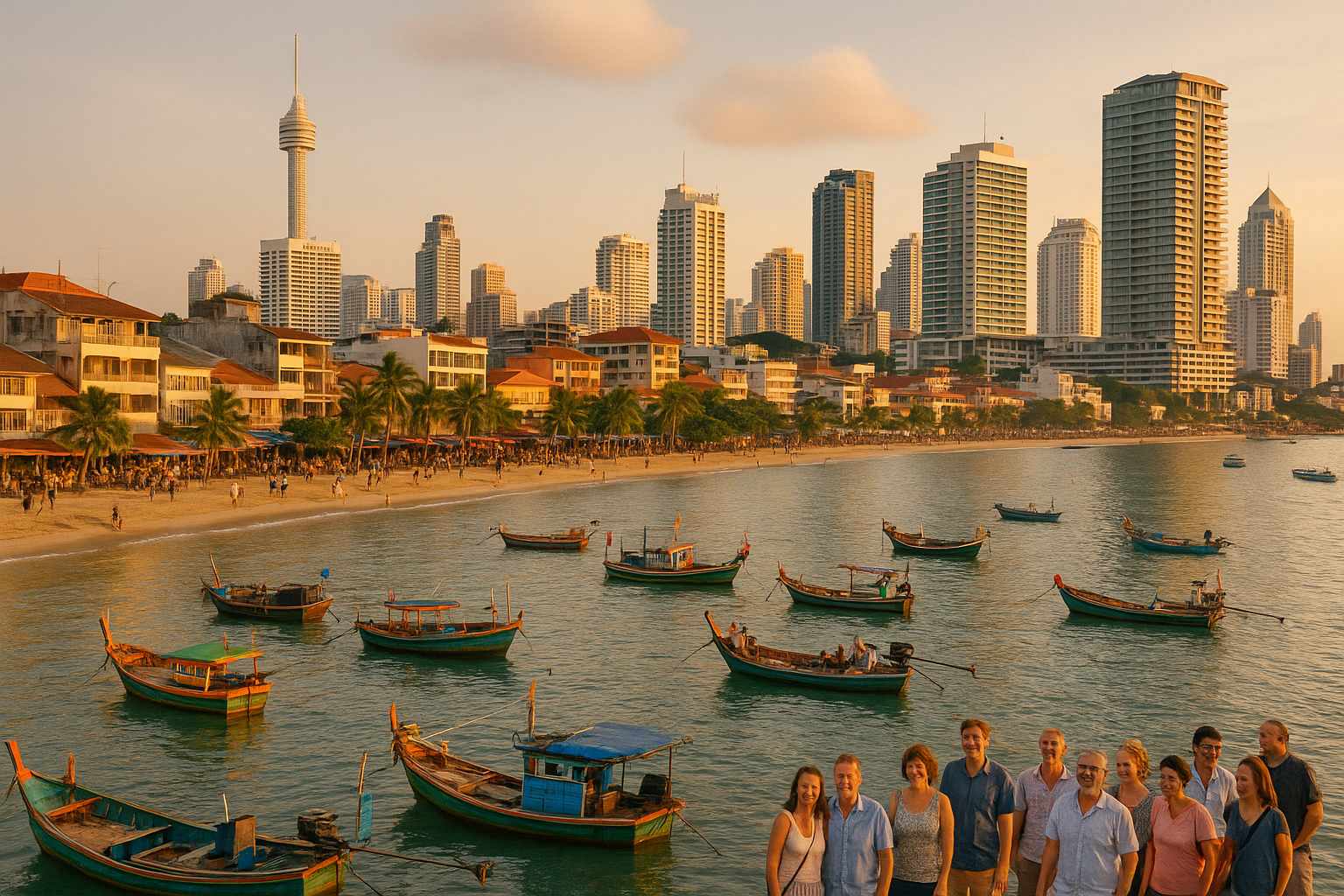
The history of pattaya is one of the most dramatic transformations of any city in Southeast Asia. In just six decades, a quiet coastal fishing settlement with a handful of wooden boats and rice paddies has become one of the most visited cities in Thailand, home to hundreds of thousands of expats, retirees and long-term visitors from every corner of the world. To truly understand Pattaya in 2026, you need to understand where it came from.
Before the Tourists: The Original Fishing Village
Before the 1960s, Pattaya was virtually unknown outside the local region. The area along the eastern Gulf of Thailand coast was home to small Thai fishing communities. Families lived off the sea. Life was quiet, simple and entirely self-contained.
The name “Pattaya” itself is thought to derive from the Thai word for the southwest wind that blew in from the sea during the monsoon season. Local fishermen used the natural harbour for shelter and the surrounding land for growing rice and vegetables. There were no hotels, no roads of any consequence and certainly no tourists.
The bay was beautiful. The water was clear. Coconut palms lined the shore. And for most of the world, it simply did not exist.
The US Military Era: How Pattaya Was Put on the Map
The single event that changed Pattaya forever was the Vietnam War.
In 1961, a group of US Army soldiers from the Special Forces stationed at Korat Air Base in northeastern Thailand drove south to the Gulf coast looking for somewhere to relax. They found the beach at Pattaya and, by most accounts, immediately fell in love with it. Word spread quickly through the US military network.
As American involvement in the Vietnam War deepened through the mid-1960s, Thailand became a key staging ground for US military operations. Several large US air bases were established in the country, and Pattaya was designated as an official Rest and Recreation (R&R) destination for US troops.
The effect on the local community was rapid and profound. Bars opened. Guesthouses appeared. Restaurants were built to serve foreign tastes. The infrastructure that had served a small fishing village was overwhelmed almost overnight by the needs of tens of thousands of American servicemen passing through on rotation.
By the late 1960s and early 1970s, Pattaya had transformed from a sleepy coastal hamlet into a loud, lively, neon-lit entertainment town. The fishing boats were still there, but they were now sharing the bay with speedboats and water sports equipment.
The Post-War Boom Years
When US forces withdrew from Southeast Asia in the mid-1970s following the end of the Vietnam War, many people expected Pattaya to fade back into obscurity. It did not.
Instead, the infrastructure and the reputation that had been built during the R&R era attracted a new wave of visitors: European and Australian package tourists. Thailand’s tourism industry was growing rapidly in the 1970s and 1980s, and Pattaya was positioned perfectly. It had beaches, accommodation, entertainment and relatively good transport links to Bangkok, which was about two hours south by road.
The 1980s were arguably Pattaya’s most explosive growth period. The population surged. Construction boomed. Hotels, condominiums and resorts rose up along the beachfront. The city expanded south toward Jomtien Beach, which became popular with a slightly different crowd, generally quieter and more family-orientated.
International airlines began flying into the new U-Tapao airport nearby. Property developers from Bangkok and overseas snapped up beachfront land. Pattaya was no longer a town. It was becoming a city.
The Royal Thai Navy Connection
One aspect of Pattaya’s history that often surprises visitors is the long and active presence of the Royal Thai Navy. U-Tapao Airport, located about 30 kilometres south of Pattaya near Sattahip, began life as a US Air Force base during the Vietnam War era and was subsequently transferred to the Royal Thai Navy following the American withdrawal.
The navy has maintained a significant presence in the Sattahip district ever since. The area around Sattahip and the Samae San islands to the south remains a naval zone, and the Royal Thai Navy uses the waters of the Gulf of Thailand for training and operations. The navy community has contributed to the long-term stability and infrastructure of the wider Pattaya region, and the relationship between the civilian city and the military installations nearby has generally been a cooperative one.
U-Tapao itself has expanded significantly in recent years and now handles both military and civilian traffic, with commercial flights connecting Pattaya to major Asian hubs.
The history of pattaya Through the 1990s and Early 2000s
The 1990s brought continued growth, though not without challenges. Pattaya developed a reputation internationally that was, at best, mixed. The nightlife economy that had roots in the R&R era continued to expand and became a dominant feature of the city’s identity. This attracted criticism and brought complicated social dynamics that the city authorities grappled with throughout the decade.
At the same time, a different kind of visitor was arriving. Retirees from Europe, Australia, North America and Japan were discovering that the combination of warm weather, low costs, modern hospitals and friendly locals made Pattaya an outstanding place to spend their retirement years. The expat community grew steadily, and with it came a demand for a broader range of services: international schools, European restaurants, golf courses, private hospitals and Western-style supermarkets.
Pattaya municipality invested heavily in public infrastructure during this period. Roads were improved. The beachfront promenade was developed. New districts such as Naklua to the north and the hillside areas of Pratumnak began to attract residential development targeting longer-stay residents rather than short-term tourists.
The 1997 Asian financial crisis hit Thailand hard and briefly slowed development, but Pattaya recovered faster than many other cities because of its diversified economy and its appeal to foreign visitors who were spending foreign currency.
The 2004 Tsunami and Its Impact
The Indian Ocean tsunami of December 2004 caused catastrophic destruction across much of Thailand’s Andaman coast, including Phuket, Krabi and Khao Lak. The Gulf of Thailand coast, where Pattaya is located, was not directly affected by the tsunami.
This geographical fact had an unexpected consequence for Pattaya. In the years following 2004, investors and visitors who might otherwise have chosen Phuket or Samui began looking more seriously at the Gulf coast. Pattaya benefited from this shift in attention and saw a notable increase in both property investment and long-stay tourism from 2005 onward.
Modern Development: The 2010s Property Surge
The decade from 2010 to 2020 saw a massive wave of condominium development transform the Pattaya skyline. Chinese investment in particular flooded the market, with large-scale developments rising along Second Road and Pratumnak Hill. Thousands of new units were built, many targeting overseas buyers looking for holiday homes or investment properties.
The city also invested in infrastructure. The road network was expanded. The beachfront on Pattaya Beach itself was redesigned, with new seawalls, improved lighting and pedestrianised sections. Jomtien saw its own wave of development, and the area around Naklua became increasingly popular with Scandinavian and Russian retirees.
Pattaya’s shopping offering expanded significantly. Large modern malls including Terminal 21, which opened in 2018 and became an immediate landmark, gave the city retail options comparable to Bangkok. International brand restaurants, cinemas and entertainment complexes appeared throughout the city.
Golf courses proliferated in the hills around Pattaya. The city established itself as one of Asia’s premier golf destinations, with over twenty courses within an hour’s drive. For many retirees, this was the clincher. You can read more about what modern Pattaya has to offer in our guide to top things to do in Pattaya for retired expats.
Covid-19: The Years That Tested the City
No account of Pattaya’s history can ignore the devastating impact of the Covid-19 pandemic. When Thailand closed its borders in March 2020, Pattaya effectively shut down overnight.
The city had been almost entirely dependent on international tourism and the expat economy. With no visitors, bars, restaurants and hotels closed in large numbers. Streets that had previously been packed with people every night of the week fell silent. Entire blocks of the entertainment district stood empty for months and then years.
The impact on the local population was severe. Many Thais employed in the tourism and hospitality sectors returned to their home provinces. Some businesses closed permanently. The property market stalled.
Yet Pattaya survived. The Thai government’s gradual reopening strategy from late 2021 brought visitors back in small numbers. By mid-2022, the pace was picking up. And from 2023 onward, the recovery gathered real momentum.
Pattaya Post-Covid: A City Rebuilt and Reinvented
The Pattaya of 2026 is noticeably different from the city that closed its doors in 2020. The recovery has not simply restored what existed before. It has, in many ways, improved it.
The years of closure gave city planners and property developers an opportunity to rethink and rebuild. New restaurants opened with a different focus. The food scene became more diverse and more sophisticated. The craft beer market grew. Wellness centres, co-working spaces and digital nomad-friendly cafes appeared in numbers that would have seemed unlikely in the pre-Covid era.
The expat community, far from abandoning the city, largely stayed. Many retirees who had been living in Pattaya before Covid remained through the pandemic and, if anything, developed a deeper connection to the city and the local community. A new wave of expats arrived in 2022 and 2023, attracted by lower property prices and a city that felt fresh rather than exhausted by over-tourism.
The Tourism Authority of Thailand has backed Pattaya’s reinvention with significant marketing investment, positioning the city as a wellness, culture and lifestyle destination alongside its existing entertainment and beach offering. Visitor numbers in 2026 have returned to and, in some segments, exceeded pre-pandemic levels.
If you are considering whether the city is right for you personally, our honest guide to is Pattaya right for me covers exactly that question in detail.
What Makes Pattaya’s Story Remarkable
The history of pattaya is remarkable not just for the speed of its transformation, but for its resilience. Other cities have risen quickly and then faded. Pattaya has risen, stumbled, recovered and reinvented itself multiple times.
It went from a fishing village to a US military R&R base. From an R&R base to a package holiday resort. From a resort town to an expat retirement destination. From a pre-pandemic boom city to a post-pandemic rebuilt city. Each phase has left something behind, adding layers to what is today one of the most complex and fascinating urban environments in Southeast Asia.
The city retains some of the character of each of those eras. The fishing community still exists in pockets, particularly around Naklua. The entertainment districts, though evolved, trace their origins directly to the 1960s R&R economy. The golf courses and private hospitals reflect the needs of the modern retiree population. The new condominiums and international restaurants speak to a city confidently facing the future.
For those of us who live here, or who are thinking about living here, understanding the history of pattaya adds depth to every corner of the city. Every street, every district and every community has a story. And that story is still being written. You can also discover some of the city’s lesser-known stories in our guide to hidden gems in Pattaya.
For official information on Thailand tourism and travel, visit the Tourism Authority of Thailand.
history of pattaya frequently asked questions
When did Pattaya first become a tourist destination?
Pattaya became a tourist destination in the early 1960s when US military personnel discovered the beach during the Vietnam War era. It was officially designated a Rest and Recreation site for US troops and began developing tourism infrastructure rapidly from around 1961 onward.
What was Pattaya before the tourists arrived?
Before the 1960s, Pattaya was a small Thai fishing community. Local families lived off the sea and farmed the surrounding land. There were no hotels, no entertainment venues and no significant foreign presence. The area was largely unknown outside the local region.
Why is the US military important in Pattaya’s history?
The US military effectively created modern Pattaya. American soldiers on R&R leave from Vietnam War duties flooded the area from the mid-1960s onward. This demand built the bars, guesthouses and entertainment infrastructure that became the foundation of the city’s tourism economy, leaving a legacy that still shapes the city today.
How did the Royal Thai Navy shape the Pattaya region?
The Royal Thai Navy took over the former US Air Force base at U-Tapao after the American withdrawal. It has maintained a significant presence in the Sattahip district south of Pattaya ever since. The base has since expanded to handle commercial flights, improving international connectivity for the wider Pattaya region.
How did Pattaya recover from Covid-19?
Pattaya’s recovery from Covid-19 accelerated strongly from 2023 onward. The city used the closure period to diversify and improve its offering. New restaurants, wellness centres and co-working spaces opened. The expat community largely stayed, and by 2026 visitor numbers have returned to and in some areas exceeded pre-pandemic levels.
Is Pattaya still growing in 2026?
Yes. In 2026, Pattaya continues to grow in population, infrastructure and international profile. New condominium developments, improved transport links via U-Tapao airport and a broader tourism offering are attracting new waves of retirees, digital nomads and long-stay visitors from across the globe.